
What Is Peach Gum? Uses, Preparation and Health Claims
Peach gum is a natural resin that seeps from the bark of Chinese wild peach trees and hardens into amber crystals. It is sold dried, soaked overnight until it swells into a soft jelly, and used mostly in sweet Chinese soups and desserts. It has almost no flavour of its own, so what it contributes is texture rather than taste.
Below is what it is, how to prepare and cook it, what the research on its claimed benefits actually tested, and who should go easy on it.
What is peach gum?
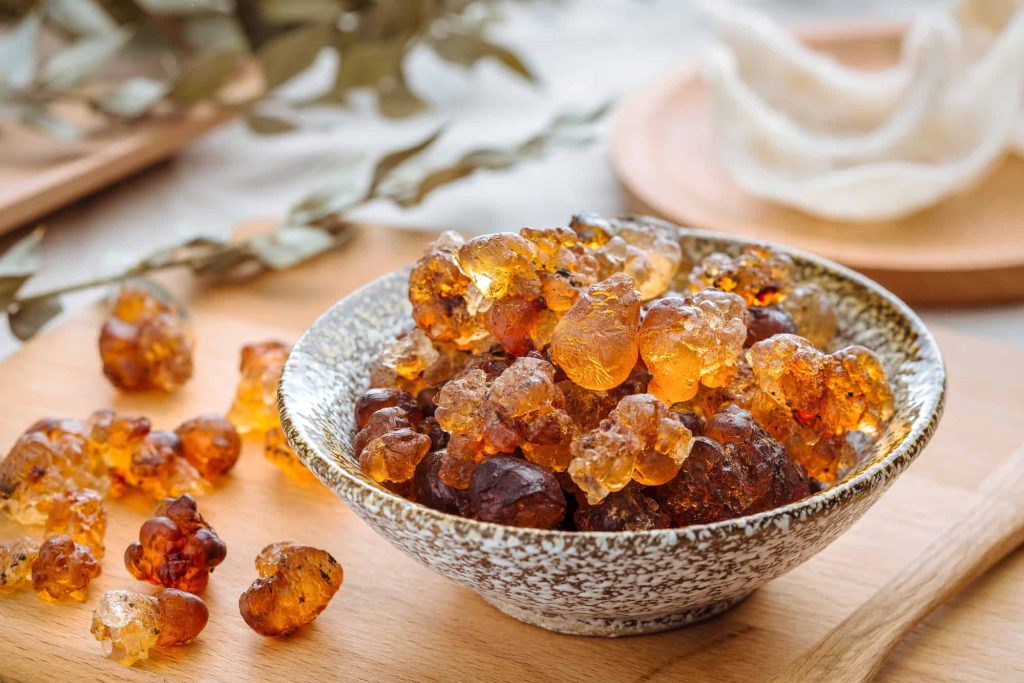
Peach gum is the gum that oozes from the trunk and branches of peach trees (Prunus persica) and Chinese wild peach trees, then dries into hard, glassy, amber lumps. In Chinese it is called tao jiao (桃胶), and it is sometimes called “tears of the peach blossom” because of how the drops look on the bark. The Michelin Guide notes it is often likened to bird’s nest, at a fraction of the price.
Chemically, it is almost entirely carbohydrate. Studies in the journal Food Hydrocolloids describe it as an arabinogalactan, a branched polysaccharide built mostly from the sugars arabinose and galactose, with smaller amounts of xylose and uronic acids. That structure is what lets it soak up water and turn into a soft, slippery jelly.
It has been eaten in China for centuries, mostly in sweet dessert soups (tong sui), and in Chinese tradition it has long been associated with beauty and good skin. Outside China, you’ll find it in Asian grocers and online, usually labelled peach gum or tao jiao.
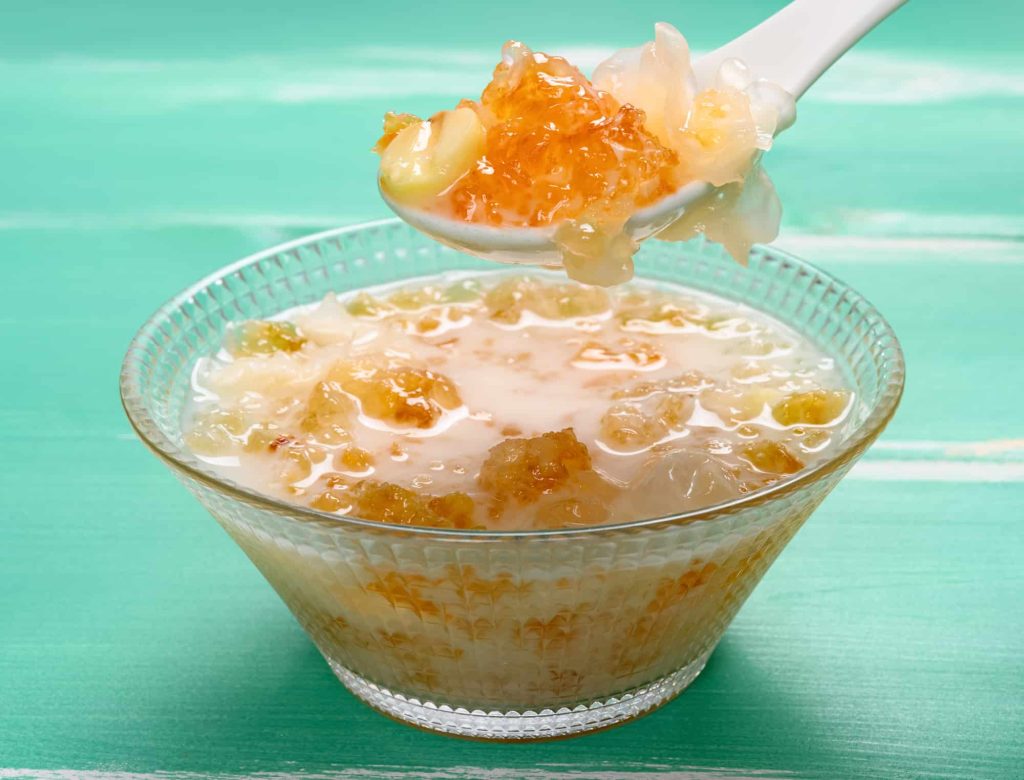
Is peach gum the same as peach resin?
Mostly, yes. “Peach resin” and “peach gum” are used for the same substance: the hardened exudate from peach trees. In practice, “peach gum” is the name it is sold under once it has been collected, sorted and dried for eating. Strictly, it is a gum rather than a resin, because it swells and softens in water, which true resins don’t.
The quality varies. Better grades are picked over by hand to remove bark and grit. Cheaper grades still carry noticeable black specks, which you remove after soaking.
How do you prepare peach gum?
Dried peach gum has to be soaked before cooking, and it grows a lot, so start small. Recipe writers broadly agree on the method but differ on the exact numbers.
| Step | Typical figure | What the sources say |
|---|---|---|
| Dried gum per serve | About 7 to 10 g | What To Cook Today uses 30 g for four serves |
| Soak time | 8 to 12 hours, or overnight | Nomadette and What To Cook Today both say 8 to 12 hours; some recipes go to 24 |
| Expansion | About 8 to 10 times its dry size | Nomadette says about 10 times; What To Cook Today turns 30 g dry into 300 g or more soaked |
| Cleaning | Pick out black specks after soaking | The softened gum makes bark and grit easy to see and lift out |
| Simmer time | About 30 minutes to 1 hour | Longer cooking makes it softer; very long soaking or cooking can turn it mushy |
Soak it in plenty of cold water in a large bowl, because it needs room to swell. Once it has puffed up and turned soft and clear, rinse it, break any big lumps into bite-sized pieces and pick out the dark bits. Nomadette warns against over-soaking, which can leave it mushy.
How to cook a peach gum dessert
This is a simple, classic sweet soup with red dates and longan.
Ingredients (serves 4)
- 30 g dried peach gum (about 1/4 cup), soaked as above
- 8 to 10 dried red dates (jujubes)
- 5 or 6 dried longans
- A few thin slices of fresh or dried ginger
- Rock sugar or honey, to taste
- About 1.2 litres of water
Method
- Soak the peach gum for 8 to 12 hours, then drain, rinse and pick out any black specks.
- Rinse the red dates and longans.
- Put the peach gum, dates, longans and ginger in a pot with the water and bring it to the boil.
- Turn the heat to low and simmer for 30 minutes to an hour, until the peach gum is soft and translucent.
- Stir in rock sugar or honey to taste. Serve hot or chilled.
For a fuller dessert, add soaked snow fungus or lotus seeds with the peach gum. A few drops of pandan extract or a strip of orange peel add fragrance.
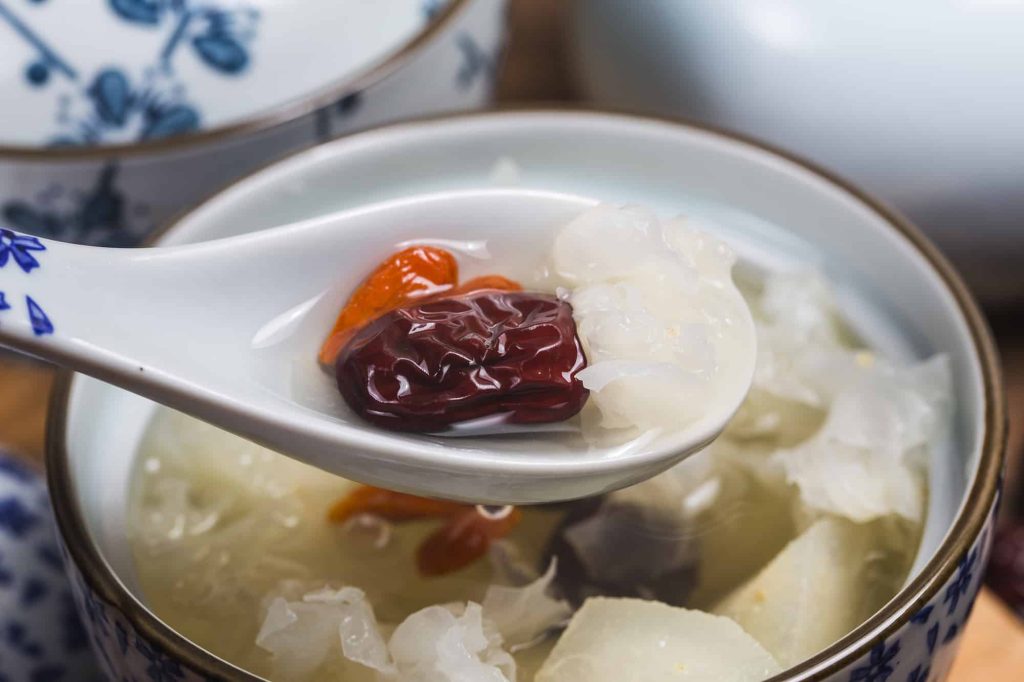
What are the claimed benefits of peach gum?
Peach gum is traditionally used in Chinese food culture for skin, beauty and general wellbeing, and it is often sold with claims about anti-ageing, digestion, immunity and blood sugar. Those claims run well ahead of the evidence. The research so far has used extracted peach gum polysaccharides in test tubes, cell cultures and animals. We could not find a single human clinical trial.
| Claim you’ll see | What was actually studied | Human evidence |
|---|---|---|
| Better skin, anti-ageing | Mice exposed to UVB light, plus human skin cells in a dish (Yang et al., 2023) | None found |
| Lower cholesterol and blood sugar | Rats with induced metabolic syndrome fed peach gum powder (Noer et al., 2023) | None found |
| Liver protection | Lab tests, liver cells and mice given alcohol (Zhou et al., 2024) | None found |
| Antioxidant, antibacterial | Lab tests, summarised in a 2022 review | None found |
| Gut health | Human stool samples fermented in a lab, not people eating it (PMC, 2022) | None found |
What can fairly be said is that peach gum is a plant polysaccharide that the stomach and small intestine don’t digest. A lab study found it passes through to be fermented by gut bacteria, which produce short-chain fatty acids. Whether that adds up to any benefit for people eating a bowl of dessert hasn’t been tested.
If you enjoy it, eat it for the texture and the tradition. Don’t rely on it to treat or manage any health condition.
Does peach gum contain collagen?
No. Peach gum is not collagen and contains essentially none. Collagen is an animal protein, and Harvard’s School of Public Health notes that in food it is found only in animal flesh with connective tissue, like meat and fish. Peach gum is a plant carbohydrate with almost no protein: one 2023 analysis measured protein at 0.18 per cent of the extracted polysaccharide.
The collagen idea seems to come from two places. Peach gum’s soft, wobbly texture looks like the gelatin you get from cooked collagen, and the 2023 Yang study reported that it reduced UVB-driven collagen breakdown in mouse skin. Reducing breakdown in mice is not the same as containing collagen, or building it in people. An earlier version of this page got that wrong.
Is peach gum fattening?
On its own, peach gum is unlikely to add much. Because the gut doesn’t digest its polysaccharides the way it digests starch or sugar, much of it passes through to be fermented rather than absorbed. There is no reliable calorie figure for it, though: it isn’t in the USDA or Australian food databases, and the figures on packets disagree widely.
What does add up is the sugar. Peach gum desserts are usually sweetened with rock sugar or honey, and that is where most of the energy in a bowl comes from. The rat study that reported better blood lipids and glucose is interesting, but it says nothing about weight in people.
What are the downsides of peach gum?
- Impurities. Dried peach gum often carries bits of bark and black grit. Soak it, then pick it over carefully before cooking.
- Quality varies. Cheaper grades carry more bark and grit, so buy from a grocer you trust and look for clean, amber pieces.
- It’s a lot of fibre-like material. Peach gum isn’t digested in the small intestine, so if you aren’t used to much fibre, start with a small bowl rather than eating it in large amounts every day.
- The sugar. A sweet soup with rock sugar is a dessert, not a health food.
Who should avoid peach gum?
- People allergic to peaches or related stone fruit should avoid it, as it comes from the same tree.
- Pregnant and breastfeeding women. There is no research on peach gum in pregnancy, so it’s sensible to check with your doctor or midwife first.
- People on medication. There’s no research on whether peach gum interacts with medicines. If you take medication for blood sugar or cholesterol, ask your GP or pharmacist before eating it regularly.
FAQs
Does peach gum taste like peach?
No. Peach gum has almost no taste of its own, just a faint sweetness at most. It takes on the flavour of whatever it is cooked in, which is why it is usually paired with rock sugar, dates, longan or snow fungus.
Is it okay to eat peach gum every day?
There’s no research on eating it daily. In normal dessert amounts it is a traditional food, but large daily amounts of any fibre-like gum can be hard going on the stomach, and the sugar it is cooked with adds up. Most people treat it as an occasional dessert.
Where can you buy peach gum?
Asian grocers and Chinese supermarkets usually stock it in the dried goods aisle, labelled peach gum or tao jiao (桃胶). It is also sold online. Look for clean, amber pieces with few dark specks.
Is peach gum vegan?
Yes. It is a plant product from peach trees, with no animal ingredients. That makes it a common vegan stand-in for the soft, jelly-like texture that gelatin or bird’s nest gives other desserts.
What goes well with peach gum?
Snow fungus, lotus seeds, red dates, goji berries, longan and pandan are all classic partners in Chinese sweet soups. It’s also sometimes added to milk or coconut-based desserts.
For another Chinese dessert ingredient with a similar texture, see what snow fungus is and what it does. If you like jellied snacks, there’s also our look at Jelly Ace, and for the wider picture, our guide to China’s regional cuisines.
Next read: snow fungus, the other classic tong sui ingredient.
Sources
- Structural features and emulsifying stability of a highly branched arabinogalactan from immature peach (Prunus persica) exudates, Food Hydrocolloids
- The mechanism of peach gum polysaccharide preventing UVB-induced skin photoaging (Yang et al., 2023), Molecules
- Hepatoprotective effects of peach gum polysaccharides against alcoholic liver injury (Zhou et al., 2024), Frontiers in Nutrition
- Ameliorative effect of peach gum on metabolic syndrome (Noer et al., 2023), Food Research
- Pharmacological importance of peach gum polysaccharide: a review, Current Bioactive Compounds
- In vitro digestion and fermentation of peach gum polysaccharides, PubMed Central
- Collagen, Harvard T.H. Chan School of Public Health, The Nutrition Source
- The Asian secret to beautiful skin: peach gum, Michelin Guide
- Peach gum dessert, Nomadette
- Peach gum tong sui, What To Cook Today