
Are Glass Air Fryers Better? Safety, Cleaning and the PFAS Question
In short
A glass bowl can cut out contact with a coated metal basket, and it lets you watch the food instead of pulling the drawer out every two minutes. It does not prove the whole appliance is free of PFAS. Most glass air fryers still sit the food on a separate crisper plate, and that plate is usually metal with a coating on it. Check the plate, the rack, the lid and the seals, then weigh what you find against the extra weight, the retained heat and the fact that glass breaks.
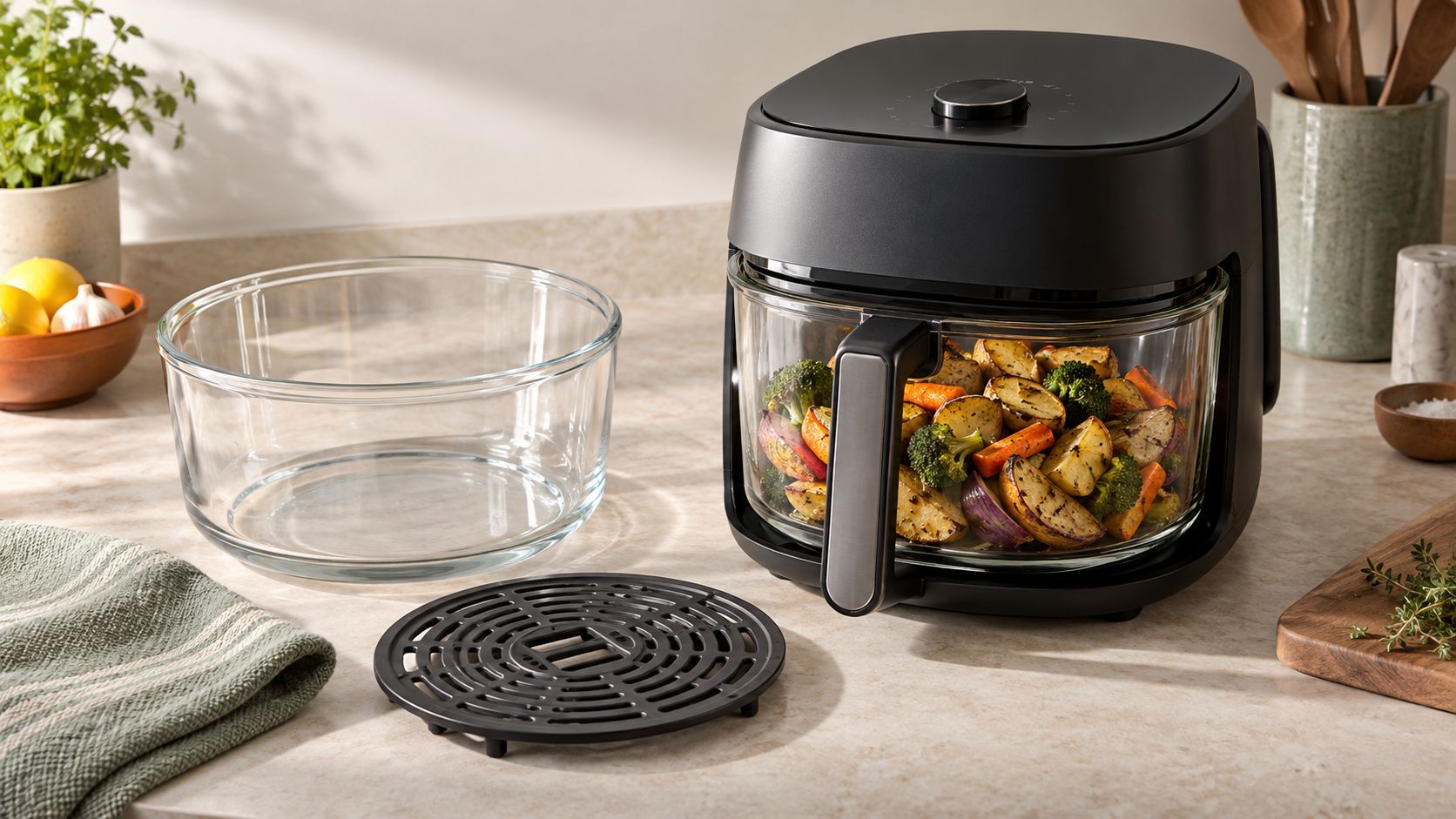
Are Glass Air Fryers Better? The Short Answer
Better at two specific things, and not automatically better overall.
Glass air fryers sell on one idea: you would rather a nonstick coating was not flaking into your dinner, so here is a bowl with no coating on it. That part is real. Borosilicate glass has no nonstick layer to scratch, and you can see through it.
The problem is that the bowl is not the only thing your food touches. Look at the photo above. The black disc on the bench is the crisper plate, and on most of these machines the food rests on that rather than on the glass. It is a separate part, usually metal, and usually coated. So a glass bowl narrows the question rather than answering it.
That does not make glass a bad buy. It makes "is it glass" the wrong question. The right one is what every food-contact part is made of, and whether the maker will say so in writing.
How Glass Air Fryers Work
Exactly like any other air fryer. A heating element and a fan push hot air fast around a small chamber, and the food browns because of the moving air rather than the hot surface it sits on.
The difference is the chamber. Instead of a coated metal drawer you get a borosilicate glass bowl, the same family of glass as lab equipment and oven dishes, with a heating head on top. Some models are built so the bowl doubles as a storage container, which is a genuine convenience: cook in it, lid it, into the fridge.
Inside the bowl there is nearly always a crisper plate, a perforated disc that lifts the food off the base so air reaches the underside. Without it you are roasting in a bowl rather than air frying. That plate is the part people forget when they buy glass for material reasons.
Glass Air Fryer Pros and Cons
| Question | Glass-bowl air fryer | Conventional basket air fryer | What to verify |
|---|---|---|---|
| Can you see the food cooking? | Yes, that is the main selling point | No, you pull the drawer out to look | Nothing. This one is straightforward |
| Is the cooking chamber coated? | No, the glass is bare | Usually yes, a coated metal basket | Whether the maker names the coating chemistry on the conventional model |
| Are other food-contact parts coated? | Often yes, especially the crisper plate | Often yes, plate and basket both | Ask what the crisper plate, rack and any lid surface are made of |
| How heavy is it to handle? | Heavier. Glass weighs more than a metal basket | Lighter | Lift one in a shop if you can, especially if you have wrist or grip trouble |
| How hot does it stay afterwards? | Hot, and for longer. Glass holds heat | Cools faster | Where you will put it down, and whether that surface can take it |
| What happens if you drop it? | It can break or chip | It dents | Whether replacement bowls are sold separately, and what they cost |
| Can it go in the dishwasher? | Often yes, but not guaranteed for every part | Often yes for the basket | The manual, part by part. Do not assume the plate matches the bowl |
| Does it crisp well? | Older models were weaker. Recent ones test well | Consistently good | Recent testing on the specific model, not the category |
| How much bench space? | Similar footprint, often shorter capacity for the size | Usually more capacity per centimetre of bench | Litres against the size of the meals you actually cook |
| Can you replace parts? | Varies a lot by brand | Varies a lot by brand | Whether bowls, plates and seals are sold as spares at all |
The entries that say "often" and "varies" are doing real work. This is a young product category and the models differ from each other more than they differ from conventional air fryers.
Are Glass Air Fryers PFAS-Free?
The glass part is. The appliance is a separate question, and the honest answer is that it depends on the model and you have to look it up.
PFAS is a large family of synthetic fluorine compounds used to make surfaces slippery and grease-resistant. PTFE, the classic nonstick coating, is one of them. They are called forever chemicals because they break down very slowly in the environment. That is as much chemistry as this needs, and it is why some people would rather not have a coated surface in the pan.
Here is the part that gets skipped: a coated part is not automatically a PFAS part. Take the Ninja Crispi, the model that made this category mainstream. Its containers are borosilicate glass, the base is BPA-free plastic and stainless steel, and its crisper plates are aluminium with a nano-ceramic coating. So there is a coating, on the exact surface the food sits on. Ninja's position is that all its food-contact surfaces are designed without PFAS and PTFE. That is the maker's claim rather than an independent test result, but it at least covers the whole system instead of just the bowl.
That is the standard worth holding brands to. Nano-ceramic and sol-gel coatings are silica-based and a real alternative to PTFE, so "coated" and "PFAS" are not the same word. Some brands go further: Fritaire states its glass cooking bowl carries no nonstick coating of any kind.
Two traps on the packaging. "PFOA-free" is not "PFAS-free", since PFOA is one compound in a very large family and that phrase has been standard on nonstick cookware for years. And "non-toxic" has no agreed definition behind it, so treat it as a prompt to go and read the specifications.
What the FDA phase-out does and does not cover
This comes up constantly and it is usually misread, so it is worth being precise.
On 28 February 2024 the US Food and Drug Administration announced that PFAS used as grease-proofing agents in food packaging were no longer being sold in the United States, completing a voluntary phase-out begun in 2020. The FDA described it as removing the primary source of dietary exposure to PFAS from authorised food-contact uses.
That is the greaseproof coating on paper and paperboard wrappers, the kind around a burger or a pastry. It says nothing about the coating on an air fryer basket, a crisper plate or a frying pan. If someone cites it as evidence that your appliance is fine, they have misread it.
Safety: Heat, Weight, Breakage and Thermal Shock
Glass introduces three handling issues that a metal basket does not have.
It gets hot and stays hot. The Good Housekeeping Institute's Kitchen and Cooking Lab noted that glass vessels get very hot and hold that heat longer than metal baskets do. Plan where the hot bowl is going to land before you lift it out, and use a mat rather than a bare benchtop.
It is heavier. Glass weighs more than a thin metal basket, and you are lifting it hot and full. Worth a thought if you have grip or wrist problems, or if the machine lives on a high shelf.
It can break. Borosilicate handles heat well and resists sudden temperature change better than ordinary glass, and makers say their glassware is built to take it. It is still glass. Thermal shock is the thing to understand: it is not the cooking heat that cracks a bowl, it is a fast change in temperature, and it usually happens in the handover moments right after cooking rather than during it.
Follow the manual, and four habits:
- Do not set a hot bowl on a cold or wet surface, including a damp benchtop or a steel sink.
- Do not run water into it to soak while it is still hot.
- Do not add anything cold to a hot bowl, or take a bowl from the fridge straight into a hot machine unless the maker says that specific model is built for it.
- Stop using a bowl that is chipped or cracked. A flaw is where a break starts.
Resist inventing your own cooling times. The manual for your machine is the authority, and the models vary.
Are Glass Air Fryers Easier to Clean?
The bowl, yes. The rest, about the same.
Bare glass is the easiest surface in the kitchen to clean, because nothing about it is delicate. You can scrub it without worrying that you are wearing off a coating, which is exactly the anxiety a coated basket creates. Baked-on grease soaks off, and it does not stain or hold odours.
Two qualifications. The crisper plate is still a perforated part with a coating on it, and perforated parts are fiddly to clean whatever they are made of, so the worst job in the machine has not gone anywhere. And dishwasher safety is per part, not per appliance. Plenty of these are dishwasher safe throughout, but read the manual instead of assuming the plate follows the bowl.
Seeing through the bowl does help here in a small way: you notice the spill when it happens rather than after it has baked on.
Do Glass Air Fryers Cook and Crisp as Well?
They did not used to. The newest ones do, and that change is recent enough to be worth stating plainly.
Good Housekeeping's Kitchen and Cooking Lab has tested these for years, and its earlier verdict was that glass models could not crisp food or reach the golden-brown colour conventional air fryers managed. That is still what a lot of older advice online repeats.
Lizzy Briskin, a contributing product analyst in that lab, went back through nine of the newest air fryers including two new glass models. The glass models the lab now recommends heat quickly, brown and crisp about as well as its favourite nonstick machines, and cost roughly the same. It names the Ninja Crispi Pro as one of the best it has tested.
Two things follow. Category-level advice about glass air fryers goes stale fast, so check testing on the model rather than on glass as an idea. And seeing in does not mean the food is cooking evenly: visibility tells you about the surface facing you, not what the underside is doing, which is why the crisper plate and the airflow still matter more than the window.
What to Check Before You Buy
Work down the machine part by part. If a brand will not tell you one of these, that silence is the answer.
- The bowl or basket. What glass, and rated to what temperature.
- The crisper plate or rack. The important one. What metal, and what coating. "Metal" on a product listing is not an answer.
- The lid or heating head. Any surface facing the food, including the underside of the head.
- The exact chemistry behind any nonstick claim. Ceramic, sol-gel, PTFE, or unstated. Remember that PFOA-free does not mean PFAS-free.
- Seals, gaskets, accessories and any liners in the box. These are food-contact parts and they are the ones nobody lists.
- Maximum temperature, for the glass and for every accessory, since they can differ.
- Dishwasher instructions per part, not one blanket statement for the appliance.
- Replacement parts and warranty. Can you buy another bowl when one breaks, and what does the warranty cover.
What you want is a maker's statement covering the whole food-contact system. "Glass bowl" on the box is not that. It is the same test worth applying to anything that touches food, which is how we went through non-toxic food storage containers: name the material, find the rating, then decide.
Point eight deserves more weight than it gets. A glass appliance whose bowl cannot be replaced is one drop away from being rubbish, which is a durability question as much as a cost one. Glass is not automatically the greener choice either. What decides that is how long it lasts and whether you can repair it.
Who Should Choose a Glass Air Fryer?
Choose glass if avoiding a coated cooking chamber matters to you and you have checked what the other parts are made of, if you like seeing the food, if the cook-store-reheat-in-one-bowl idea suits how you eat, and if the weight and the breakage risk do not bother you.
Stay with a conventional basket if you want the most capacity for the bench space, if lifting a heavy hot bowl is a problem, if the machine gets handled roughly or by kids, or if you have found a conventional model whose maker documents its materials properly. A well-documented coated machine beats a vague glass one.
The worst outcome is paying a premium for a glass bowl, assuming the job is done, and never looking at the crisper plate.
Frequently Asked Questions
Are glass air fryers actually PFAS-free?
The glass bowl has no coating on it. Whether the whole appliance is free of PFAS depends on the crisper plate, the rack, the lid surfaces and the seals. Some makers state that every food-contact surface is designed without PFAS and PTFE. Others say nothing beyond the bowl. Check before you assume.
Can a glass air fryer bowl shatter?
It can break, and the usual cause is thermal shock rather than the cooking heat. Setting a hot bowl on a cold or wet surface, rinsing it too soon, or adding something cold to it are the common triggers. Borosilicate resists sudden temperature change better than ordinary glass but is not immune. A chipped or cracked bowl should be retired.
Do glass air fryers crisp as well as normal ones?
The current ones largely do. Good Housekeeping's lab found that earlier glass models could not brown and crisp like conventional air fryers, but the glass models it now recommends heat quickly and crisp about as well as its favourite nonstick machines. Check reviews of the specific model, since the category has moved quickly.
Is the crisper plate in a glass air fryer coated?
Usually. It is normally metal with a coating, because a bare metal plate would stick. On the Ninja Crispi the plates are aluminium with a nano-ceramic coating. A ceramic coating is not PTFE, so coated does not automatically mean PFAS, but it does mean there is a coated surface under your food.
Does the FDA PFAS phase-out mean my air fryer is safe?
No. That phase-out covers PFAS used as grease-proofing agents on paper and paperboard food packaging, completed in February 2024. It does not cover cookware or appliance coatings, and it does not certify any particular product.
Can you put the glass bowl straight in the fridge?
On models designed as cook-and-store systems, yes, and that is one of the better reasons to buy one. Going the other way, fridge-cold straight into a hot machine, is the move to check the manual about first, since that is a sharp temperature change.
The Bottom Line
Buy glass if you want to see the food and you would rather your cooking chamber had no coating on it, provided you have checked the crisper plate and you are comfortable with something heavier that holds its heat and can break. Otherwise buy a conventional model whose maker will tell you what its surfaces are made of, which is worth more than the bowl material on its own.
Either way, judge the whole cooking system rather than the one part the marketing leads with. The same thinking applies to what you put in the basket, which we went through for silicone and parchment air fryer liners. There are more kitchenware guides here.