
Air Fryer Liners: Silicone vs Parchment, Which Is Better?
The short answer
Parchment is usually the better liner. It is thin, it conducts heat well, and it goes in the bin with the mess on it. A thin silicone liner with low sides is the better choice for sticky and saucy food, because it holds a glaze that would run through paper, and you wash it instead of buying more. The thing that decides it is not the material, it is the thickness and the height of the sides. Anything thick or deep blocks the airflow that makes an air fryer work.
Safety
Never preheat an air fryer with loose parchment inside. The fan can lift unweighted paper into the heating element, where it can scorch or catch fire. Put parchment in only when the food is ready to go on top and hold it flat, keep it clear of the element, and stay inside the temperature limit printed on the liner packet and in your appliance manual.
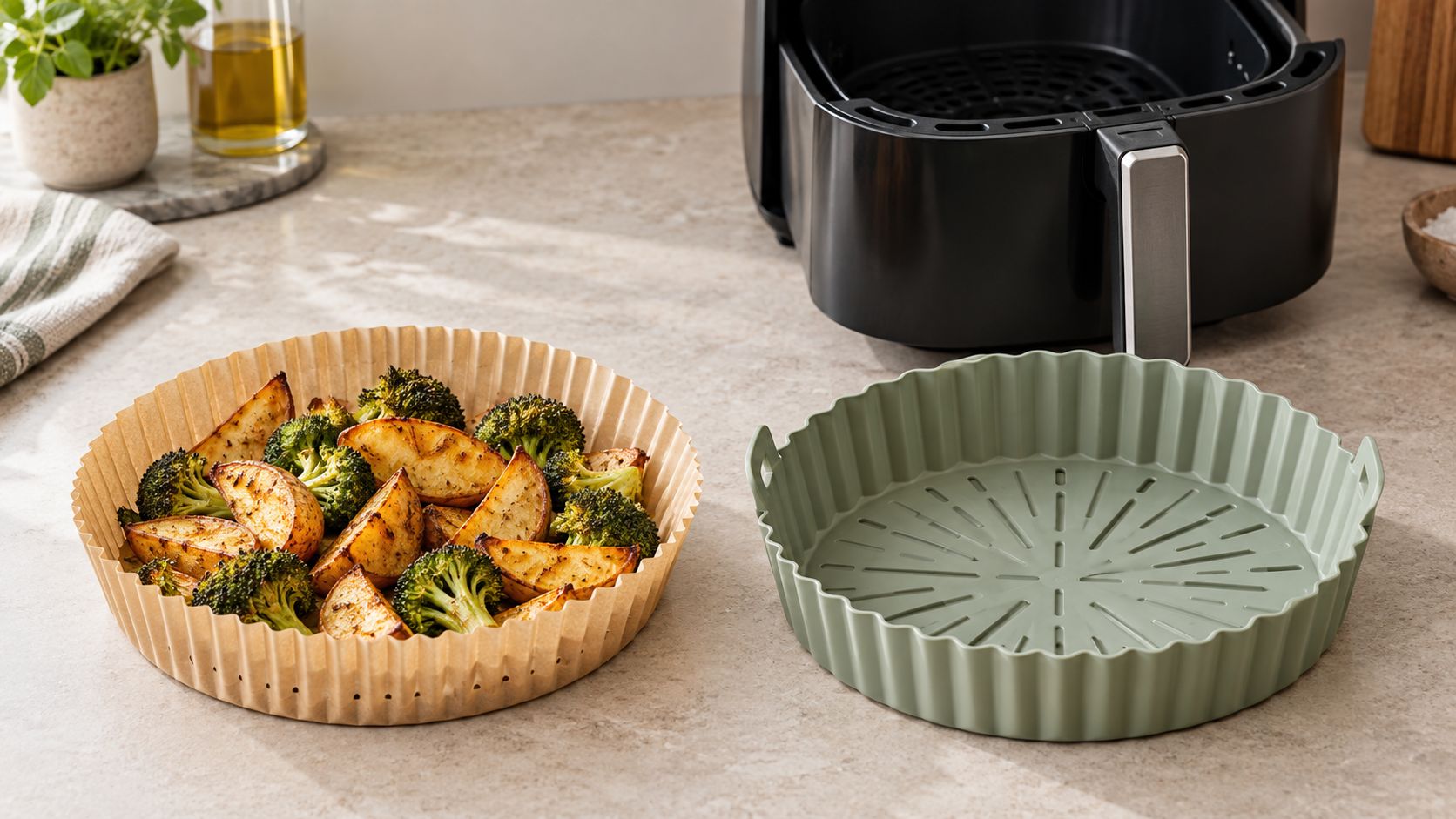
Silicone vs Parchment Air Fryer Liners: The Short Answer
An air fryer is a small fan oven. The fan is the whole mechanism, and a liner is something you put in the path of it. That is the frame for every question below.
America's Test Kitchen tested both kinds and picked one parchment set and one silicone set. What its favourites shared was not the material: both were lightweight with low sides, which let heat move around the food without stretching cooking times. Its rule for silicone was thinner than 2mm. Parchment conducts heat relatively well, so it passes through to the food underneath. Silicone conducts less, which is why thickness matters more for silicone than for paper.
So: perforated parchment, or no liner, for the crispiest result. Thin low-sided silicone for anything sticky or saucy, accepting slightly slower browning. If your only silicone liner is thick with tall walls, you are better off without it.
Are Air Fryer Liners Safe?
Yes, on conditions, and one of those conditions causes almost every problem people report.
The condition is weight. Reynolds, which makes the parchment liners most people buy, says to preheat the air fryer with nothing in it, put the liner in after preheating, and put food on top straight away so the paper is weighed down on all sides. Their stated reason is exactly the failure mode: weighing the liner down keeps it from touching the heating element while the unit is heating, and contact with the element is a fire hazard. Reynolds rates its liners to 400F, or 204C.
Take that 400F as Reynolds' number for Reynolds' product, not as a universal ceiling. Some liners are rated lower. Some air fryers run hotter. Whichever limit is lower, the packet's or the appliance's, is your limit.
The other condition is fit. A liner that is too big rides up the sides and can reach the element. One that covers the perforations in the basket floor stops air reaching the underside of the food, which is half of what an air fryer does. Check your own manual before treating any of this as settled, because instructions for a specific model beat generic advice, including ours.
One thing to leave alone: the trick going around online of holding parchment down with a magnet, a clip or a rack. No appliance maker recommends putting improvised weights inside an air fryer. Food is the weight.
Parchment Liners: Pros, Cons and Best Uses
Parchment liners are single-use paper discs or squares, usually sold perforated. The perforations are not decoration. They are how air gets underneath.
What parchment does well: it is thin, so it barely interferes with cooking, it conducts heat better than silicone, and it lifts out with the grease and crumbs on it straight into the bin. It is also cheap enough that nobody agonises over using one.
Where it falls down: you keep buying it, it makes rubbish, and it is the one that can lift. It also leaks. Perforated paper is not a container, so a glaze runs through the holes onto the basket you were trying to keep clean.
Two distinctions worth holding onto. Perforated parchment liners are not the same as solid parchment, which blocks airflow entirely across the basket floor. And neither is the same as ordinary baking paper cut to shape, which has no perforations and may carry a different temperature rating from the liners sold for air fryers. Wax paper is not parchment at all and does not belong in a hot air fryer.
Silicone Liners: Pros, Cons and Best Uses
Silicone liners are reusable trays or mats, and the good ones are thin and shallow. The bad ones are thick and deep, and they are common, because a deep tray looks more useful on a product page.
What silicone does well: it holds liquid, so a wing glaze or a marinade stays in the tray rather than on the basket. It is reusable, so there is no ongoing cost and no waste. And it is too heavy to be lifted into the element.
Where it falls down: it conducts heat less readily than paper, so food browns more slowly underneath, and tall sides shield it from the moving air. Thickness and height compound each other, and past a point you have turned your air fryer into a slow, bad oven.
Reusable also does not mean maintenance-free. Silicone holds grease in a way paper never gets the chance to, and it picks up smells, so a tray you have cooked fish or garlic in can pass that on to the next thing. It has to be washed properly, and it has to be dry before it goes back in.
Do Liners Stop Food From Crisping?
The wrong liner does. The right one mostly does not.
Crisping depends on hot air moving fast over every surface of the food, the bottom included. Three things interrupt that: a solid floor stops air reaching the underside, high sides break up the circulation, and a thick material absorbs heat that should have gone into browning. That is why thin low-sided liners tested without stretching cooking times and thick ones did not, and why no liner is still the right answer when crunch is the entire point.
If you use a liner and your chips come out pale, the liner is the first suspect, not the recipe.
Which Air Fryer Liner Should You Use by Food?
| Food or situation | Best choice | Why | Watch out for |
|---|---|---|---|
| Breaded chicken, chips, wedges | Perforated parchment, or nothing | Crunch needs air under the food | A solid liner leaves the bottoms pale |
| Bacon, sausages, fatty cuts | Parchment made for air fryers, if the manual allows | Catches rendered fat, saves scrubbing | Keep it weighted and clear of the element; do not overfill, fat pools |
| Sticky glazed wings, marinated tofu | Thin, low-sided silicone | Holds the glaze instead of letting it run through | Slower browning; turn the food if one side stays pale |
| Biscuits and delicate baked things | Parchment cut to fit the basket | Releases cleanly without tearing the base off | Place liner and dough together, so it is weighted from the start |
| Wet batter | Silicone, if the recipe and appliance allow it | Batter runs straight through perforated paper | Wet batter often does not air-fry well at all |
| Reheating pizza or dry leftovers | Nothing, or perforated parchment | Little mess to catch, and airflow revives the base | A liner here costs crispness for no real gain |
| Anything light, before cooking | No loose parchment | Light food cannot hold paper down against the fan | This is the setup that lifts a liner into the element |
Two things override this table every time: the instructions for your own air fryer, and the directions on the food packet. If a frozen product tells you to cook it directly on the basket, do that.
How to Use an Air Fryer Liner Safely
The order matters more than anything else here.
- Preheat the air fryer empty. No liner in the basket.
- Check the liner fits the basket without riding up the sides, and that it does not cover more of the basket floor than it needs to.
- Put the liner in flat once preheating has finished.
- Put the food on top straight away, spread out so the liner is held down at the edges as well as the middle.
- Stay under whichever temperature limit is lower, the liner's or the appliance's.
- If you open the drawer partway through and the liner has curled up at an edge, push it back down under the food before you carry on.
Never leave a liner in an empty running machine, and never put one in and walk away before the food goes on.
Can You Reuse Air Fryer Liners?
Silicone yes, parchment no.
Silicone liners are made to be washed and used again, and many are dishwasher safe, though hand washing is gentler on them over time. Check the temperature rating and the dishwasher instruction for the actual product rather than assuming.
Parchment is designed to be thrown away. It has already been through a full cooking cycle, it has absorbed fat, and washing it destroys the paper. A liner that has browned, gone brittle or torn is finished even if you only used it once.
Replace a silicone liner when it goes sticky or tacky in a way that will not wash off, when it stays smelling of the last thing you cooked, or when it tears, warps or discolours badly. None of those is an emergency, they just mean it has stopped doing its job.
A Note on Materials and Non-Toxic Claims
Liners get sold as "non-toxic" constantly, and on its own the word means nothing. It is marketing, not a specification. What tells you something is the material named, the temperature it is rated to, and whether the maker says what any coating is. Food-grade silicone and unbleached parchment are both ordinary, well-understood kitchen materials. An unbranded liner with no stated material, no rating and no maker behind it tells you nothing, which is the real reason to skip it.
This is the same test worth applying to the appliance itself, which is why we went through it component by component for glass air fryers and the PFAS question, and the same one behind our pick of non-toxic food storage containers. Name the material, find the rating, then decide.
Frequently Asked Questions
Can air fryer liners catch fire?
Parchment can. It is light enough for the fan to lift it into the heating element, where it can scorch or ignite. It happens when the liner goes in without food on top, most often during preheating. Silicone liners are too heavy to be lifted, which is the one safety advantage they hold over paper.
Can you put a liner in while the air fryer preheats?
No. Preheat with the basket empty and add the liner afterwards, with the food going straight on top of it. Reynolds gives this as a direct instruction for its own liners, and it is the single rule that prevents most liner problems.
Can you use regular baking paper instead?
Only if you check two things: its temperature rating, and that you have cut it to fit without covering the whole basket floor. It will not be perforated, so air cannot reach the underside of the food, and the same weighting rule applies with more force because a plain sheet is even more likely to lift. Wax paper is a different product and is not suitable.
Can you use aluminium foil in an air fryer?
Check your manual first, because some makers advise against it. Where foil is allowed, the same rules apply: weight it with food, keep it clear of the element, and do not cover the whole basket floor. Foil also holds acidic food badly, so tomato and citrus marinades are better off on silicone.
Do air fryer liners affect cooking time?
A thin, low-sided liner of either material can be used without stretching cooking times. Thick silicone and tall sides slow things down, because they block the circulating air and absorb heat that would otherwise brown the food. If you switch to a thick liner and your usual timings stop working, that is why.
Do you need an air fryer liner at all?
No. Air fryer baskets are made to be cooked in directly, and for anything you want properly crisp, no liner is the best setting. A liner is a cleanup tool, so use one when the mess justifies it and skip it when it does not.
The Bottom Line
Match the liner to the food rather than picking one and using it for everything. Perforated parchment for crisp and dry things, thin low-sided silicone for sticky and wet things, nothing at all when maximum crunch matters. Keep the airflow open, and never let loose parchment preheat on its own.
There are more practical kitchenware guides here, including how to cook frozen pizza without an oven.