
Is Methylcellulose Safe to Eat? What It Is, Where It's Used and the Laxative Claim
The short answer
Methylcellulose is a fibre made from plant cellulose. It is used in small amounts to hold foods together, including plant-based and 3D printed meat. The US FDA lists it as generally recognised as safe, the EU permits it as E461, and it is a permitted additive in Australia and New Zealand. It is also sold on its own as a bulk-forming laxative, but at doses of 2 g or more at a time, which is far more than a serve of food carries.
Yes, methylcellulose is safe to eat at the amounts used in food, according to every major food regulator that has looked at it. The “it’s a laxative” line you may have seen online is true in one narrow sense and misleading in the way it is usually meant. Here is what the ingredient is, where it turns up, and what the dose has to do with it.
What is methylcellulose?
Cellulose is the fibre that gives plant cell walls their structure. It is in every vegetable you eat, and your body cannot digest it. Methylcellulose is cellulose, usually from wood pulp or cotton, that has been treated with an alkali and then with methyl chloride so that some of its hydroxyl groups are swapped for methyl groups (Green Queen). That small chemical change makes it dissolve in cold water, which plain cellulose will not do.
It has one unusual property that food makers prize. Most gels set when they cool. Methylcellulose does the opposite: it forms a gel when heated and turns back into a thick liquid as it cools (BAKERpedia). That is why it works as a binder in a burger or a printed steak. Cold, it lets the mix flow or be shaped. In the pan, it firms up and holds the piece together, so it does not fall apart on the grill.
On a label it appears as “methylcellulose”, “methyl cellulose”, or in the EU and Australia as additive number 461 (Food Standards Code Schedule 8).
Which foods contain methylcellulose?
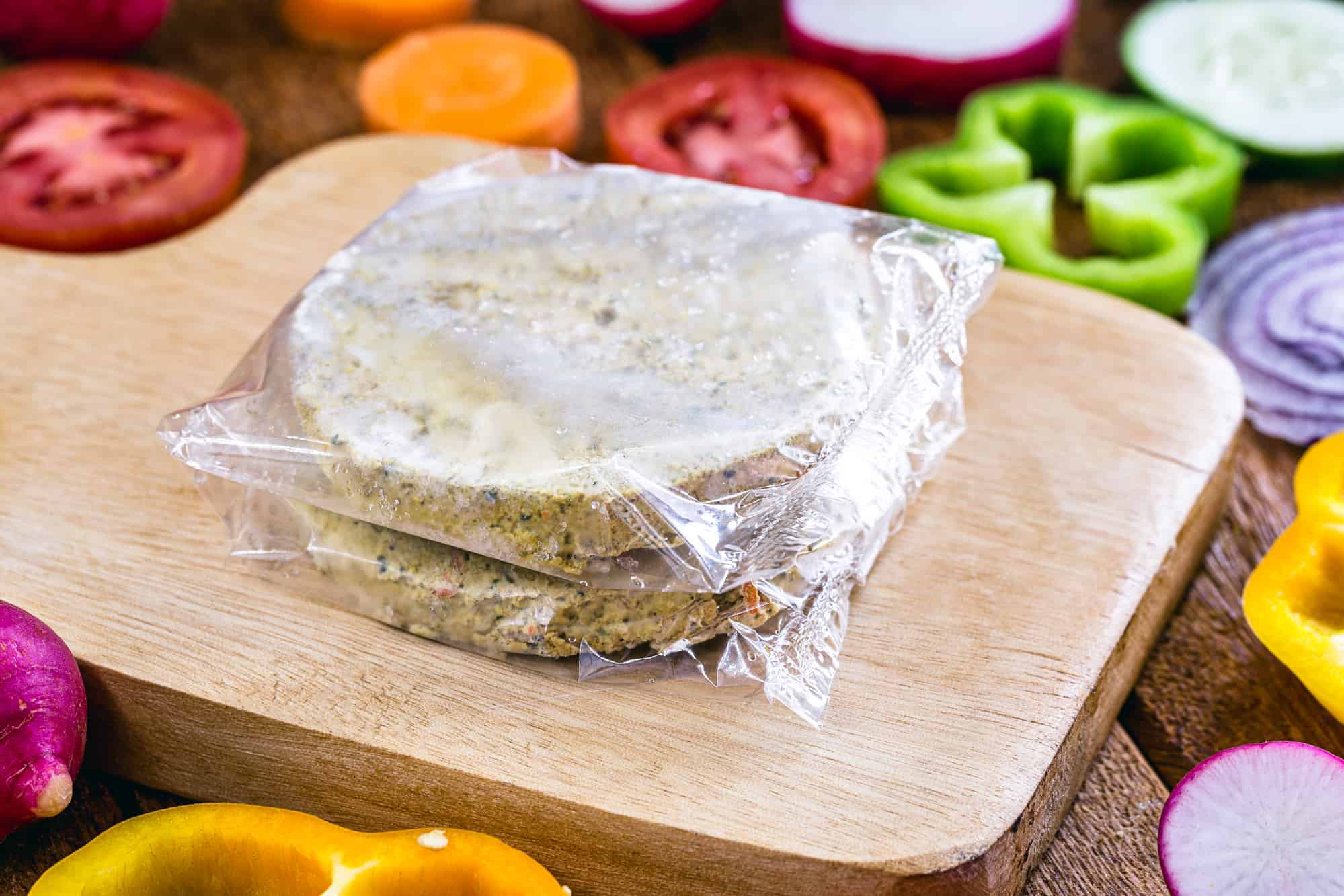
The most talked-about use is in meat alternatives. Impossible Foods and Beyond Meat both use it in their burgers, and both told TODAY it makes up less than 2 per cent of the patty by weight, so under 2 g in a typical serve (TODAY). Every product in Steakholder Foods’ 3D printed Perfecta range lists it too. On the marbled steak it is the fifth ingredient, after water, soy flour, rapeseed oil and coconut oil (Open Food Facts). We go through that label line by line in Perfecta 3D printed steak: what’s in it.
Other places it turns up:
- Gluten-free baking. Gluten is what makes wheat dough stretch and hold gas. Without it, bread crumbles. Methylcellulose is one of the binders bakers and manufacturers use in its place, and it is in several commercial egg-replacer powders (BAKERpedia). If you bake without wheat, our gluten-free guide covers the foods where gluten hides.
- Sauces, fillings and frozen desserts. It thickens, stabilises and stops ice crystals forming, so it appears in some sauces, pie fillings and ice creams. Codex lists it as an emulsifier, stabiliser and thickener.
- Fried foods. A methylcellulose coating can reduce how much oil a batter soaks up.
If you want the broader picture of what goes into a plant-based burger, what chemicals are in plant-based meat and burgers covers the common ingredients side by side.
Is methylcellulose approved by food regulators?
Yes, in every major market we checked.
| Regulator | Status |
|---|---|
| US FDA | Listed in 21 CFR 182.1480 as generally recognised as safe (GRAS) when used in line with good manufacturing practice |
| European Union | Permitted as E461. EFSA’s 2018 re-evaluation found no safety concern at reported uses and saw no need for a numerical acceptable daily intake |
| Australia and New Zealand | Permitted as additive 461 under the Food Standards Code, at the level needed to do the job (GMP) |
| JECFA (WHO and FAO) | Acceptable daily intake “not specified”, the category used for additives of very low concern |
The FDA entry is one line: methylcellulose is generally recognised as safe when used in accordance with good manufacturing practice, with a specification for how much of the cellulose has been methylated (21 CFR 182.1480).
The European Food Safety Authority looked at the whole cellulose family together in an opinion adopted in 2017 and published in 2018. Its conclusion was that there was no need for a numerical acceptable daily intake and no safety concern at the reported use levels (EFSA Journal). EFSA did note that toxicity data were not available for every cellulose and every endpoint, and the European Commission issued a call for further data on the group in 2023, which is routine follow-up rather than a withdrawal. The additives stay on the market while that data is gathered (European Commission).
In Australia and New Zealand, methyl cellulose (461) is a permitted food additive under Schedule 15 of the Food Standards Code, at good manufacturing practice level rather than a fixed cap (Food Standards Code). “GMP” means a maker can use as much as is needed to do the job and no more, which is the category used for additives the regulator considers low risk.
Is methylcellulose a laxative?
This is the claim doing the rounds on social media, so it is worth being precise.
The same substance is sold over the counter as a bulk-forming laxative. Citrucel is the best-known brand. Its powder delivers 2 g of methylcellulose per heaped tablespoon, taken in a full glass of water, and the adult label allows up to three doses a day. The caplets are 500 mg each, up to 12 a day (Drugs.com). So a laxative dose is roughly 2 g at a time and up to about 6 g a day, swallowed with a lot of water, with the specific aim of adding bulk to the stool.
Compare that with food. Impossible and Beyond say their patties carry under 2 g in total, and Perfecta’s steak lists methylcellulose fifth, behind water, soy flour and two oils, so a 250 g serve plausibly carries a few grams at most. Neither company publishes the exact figure. A serve of plant-based meat is in the same range as, or below, one laxative dose, and it is eaten as part of a meal rather than as a bulking agent in water.
It is also fibre. Methylcellulose is a laxative in the way any dietary fibre is: it holds water and adds bulk. Calling the binder in a burger “a laxative” is a bit like calling the oats in your porridge one.
The honest summary: the substance is used as a laxative, at a laxative dose. The amount in a serve of food is small, and there is no evidence it has a laxative effect at those amounts in most people.
What happens to methylcellulose in your body?
Nothing much, which is the point. Celluloses are not absorbed. They pass through the small intestine unchanged and leave the body in the stool. Unmodified cellulose is barely fermented by gut bacteria, while modified celluloses such as methylcellulose may be fermented to a small degree in the large bowel (European Commission). It adds no calories, no protein and no fat. On a nutrition panel it counts towards fibre, which is part of why plant-based steaks show fibre where beef shows none.
That fibre is not the same as the fibre in whole vegetables, which comes with vitamins and minerals. Treat the fibre figure on a plant-based meat label as a bonus, not a reason to eat it.
Does methylcellulose have side effects?
At food levels, side effects are rare. At laxative doses, the known effects are the ones you would expect from any bulk fibre taken quickly: bloating, wind, cramps or looser stools, especially in someone not used to much fibre. Taken without enough water, a bulk-forming laxative can swell in the throat, which is why the packets say to drink a full glass with each dose. That warning is about the supplement, not about a burger.
EFSA’s 2018 review found no safety concern at the amounts people actually eat from food, and that estimate included heavy consumers of foods containing the whole cellulose family (EFSA Journal). Newer research on a related additive, carboxymethylcellulose (E466), has looked at effects on gut bacteria in mice and in small human studies. Those findings concern a different cellulose at high intakes, and they are part of why the EU asked for more data.
If you have a bowel condition, are on a restricted diet, or notice that a particular product does not agree with you, talk to your doctor or a dietitian rather than guessing at the cause from an ingredient list.
Common questions
Is methylcellulose vegan?
Yes. It is made from plant cellulose, usually wood pulp or cotton, with no animal inputs.
Is methylcellulose gluten free?
Yes. It is derived from cellulose, not from wheat, barley or rye, and it is widely used as a binder in gluten-free products. Check the rest of the ingredient list, because the product it sits in may still contain wheat.
Is methylcellulose natural or synthetic?
Both, depending how you define the words. The raw material is natural plant cellulose. The methyl groups are added by a chemical reaction, so the finished ingredient is a modified cellulose. Regulators treat it as a food additive, which is why it carries the number 461.
How much methylcellulose is in a plant-based burger?
Impossible Foods and Beyond Meat both say less than 2 per cent of the patty by weight, which works out to under 2 g in a standard patty. Steakholder Foods has not published a figure for Perfecta, but methylcellulose is the fifth ingredient on its steak label.
Can methylcellulose cause bloating?
In laxative doses it can, like any bulk fibre. At the amounts in a serve of food, bloating is unlikely for most people, though anyone who reacts to a product should take that seriously and check with a doctor.
Is methylcellulose the same as cellulose gum?
No. Cellulose gum is carboxymethylcellulose (E466), a different modification of the same starting material. Both are binders and thickeners, but they behave differently and have been reviewed separately.
The bottom line
Methylcellulose is a purified plant fibre that helps processed foods hold their shape, and it is permitted by the FDA, EFSA, FSANZ and the WHO’s additive committee. The laxative claim rests on the fact that the same ingredient is sold as a bulk-forming laxative at 2 g a dose, which is more than most serves of food carry and used in a completely different way. If a plant-based steak does not agree with you, the soy, wheat or salt in it are more likely suspects than the binder.
Read next: 3D printed meat: the plain-English guide, Perfecta 3D printed steak: what’s in it, What chemicals are in plant-based meat and burgers? and Is 3D printed meat safe to eat?
Sources
- 21 CFR 182.1480 Methylcellulose, US Code of Federal Regulations, via Cornell Legal Information Institute
- Re-evaluation of celluloses E 460(i), E 460(ii), E 461, E 462, E 463, E 464, E 465, E 466, E 468 and E 469 as food additives, EFSA Journal, 2018
- Call for technical data on the permitted food additives microcrystalline cellulose, powdered cellulose and modified celluloses (E 460 to E 465, E 468 and E 469), European Commission, 2023
- Methyl cellulose (INS 461), JECFA, WHO food additives database
- Schedule 15: Substances that may be used as food additives, Australia New Zealand Food Standards Code
- Schedule 8: Food additive names and code numbers (for statement of ingredients), Australia New Zealand Food Standards Code
- Citrucel dosage guide, Drugs.com
- Do Impossible and Beyond Meat burgers really contain laxatives?, TODAY
- Methylcellulose: what is it, why it's used in plant-based meat, and the startups making alternatives, Green Queen
- Methylcellulose, BAKERpedia
- Plant-Based Burgers with Reduced Texture Additives: A Comparative Study of Methylcellulose and Sodium Alginate, PubMed Central, 2025
- Perfecta Plant-Based Marbled Steak, Open Food Facts
Related
Start with the guide: 3D printed meat: the plain-English guide
- Perfecta 3D-printed steak: what is in it?Perfecta is a plant-based range made mainly from soy and wheat protein and printed in layers. It is not real meat and it is not grown from animal cells.
- What is 3D printed meat, and is it safe to eat?The plant-based 3D printed meat on US shelves is covered by the same food safety rules as any packaged food. Lab-grown meat goes through its own review before it can be sold.
- What does 3D printed steak taste like? What the reviews say so farNot much like steak, going by the reviews so far. A Washington Post reviewer found Perfecta dense and artificial-tasting, WIRED found an earlier Steakholder steak dry and bland inside, and Redefine Meat's printed flank steak gets better marks for texture.
Also on Cuisine Seeker: Why do I crave sugar at night?