
Hot Pot at Home: How to Set It Up and Run It
The short answer
Hot pot is a simmering pot of broth in the middle of the table that everyone cooks their own food in. You need a portable burner, a wide shallow pot, enough broth to fill it two thirds, and a dipping sauce each. Thin meat takes seconds, seafood and tofu take minutes, and noodles go in last so they do not turn the broth to starch.
This is the guide underneath the rest of our hot pot writing. It covers the equipment, the setup and the running of the meal. What to buy is in the hot pot ingredients list, and what to do with what is left in the pot afterwards is in can you reuse hot pot broth.
What Is Hot Pot?
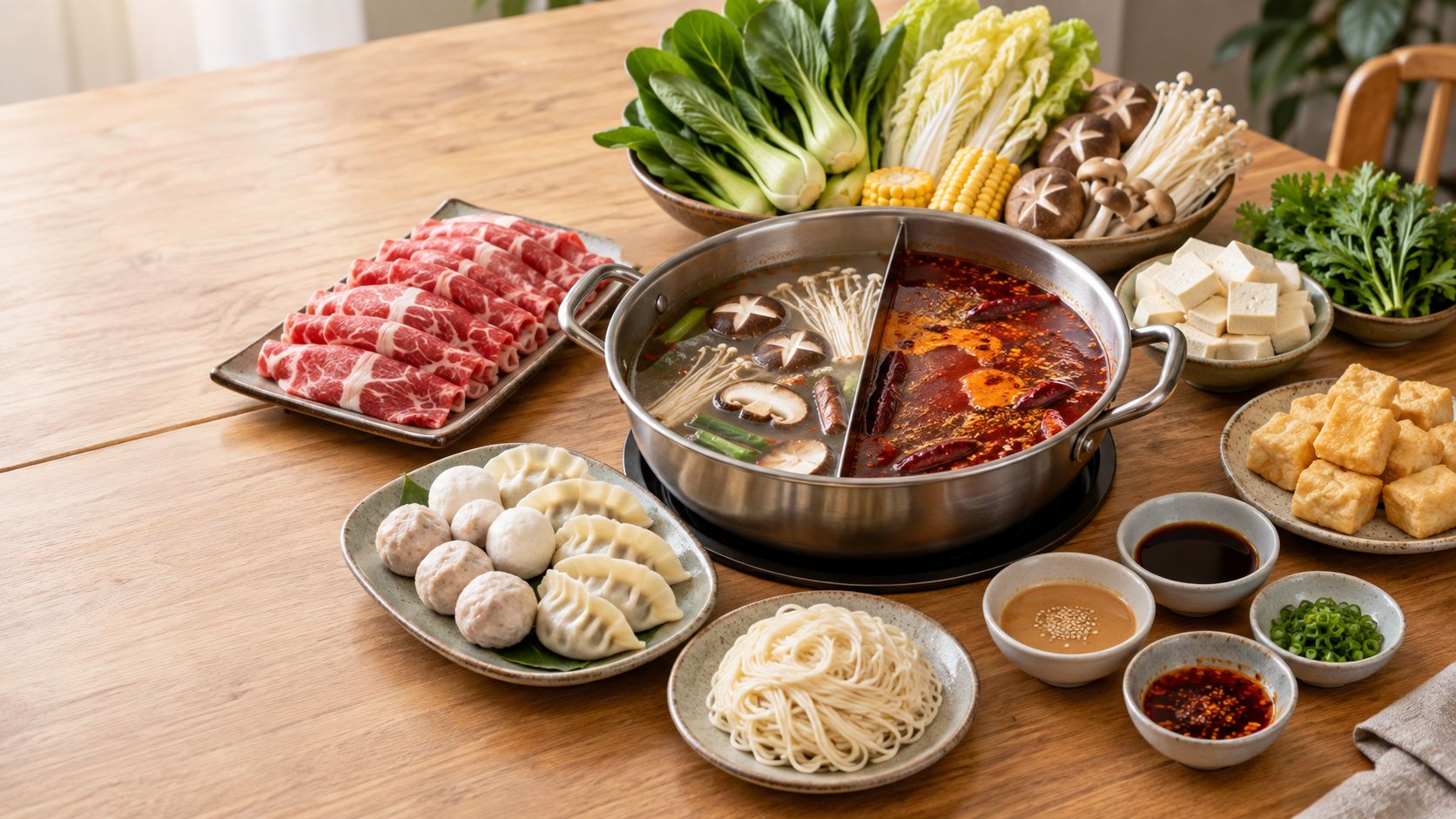
Hot pot is a shared pot of simmering broth kept hot at the table, with raw ingredients laid out around it. Everyone cooks their own pieces, a few at a time, and dips them in a sauce they have mixed themselves. Nothing is plated in the kitchen and nothing arrives finished.
That makes it a fundamentally different kind of meal to cook for. There is no timing to get right and no moment when everything has to be ready at once. You do the shopping and the chopping, then you sit down with everybody else.
The Chinese versions are the ones most people mean, and they vary a lot by region.
- Sichuan and Chongqing mala. The famous one. Dried chilli, chilli bean paste and Sichuan peppercorns, giving heat plus the numbing tingle that ma refers to.
- Beijing lamb hot pot. A plain broth in a ring-shaped copper pot, thin lamb, and a sesame dipping sauce doing most of the flavour work.
- Cantonese. Lighter, often seafood and chicken, with the broth treated as something you drink at the end rather than just a cooking medium.
- Yin-yang or divided. Not a region, a pot. Two broths at once, usually one spicy and one mild, which is how most home tables solve the problem of feeding people with different tolerances.
The idea is not only Chinese. Japanese shabu-shabu is the same principle with a kombu broth and a very light touch, Korean jeongol is a richer, more built-up version, and Thai suki comes with a sweet chilli dipping sauce. Our guide to Chinese regional cuisines has more on where the Sichuan version sits.
What Equipment Do You Need?
Less than you would expect, and none of it has to be specialist.
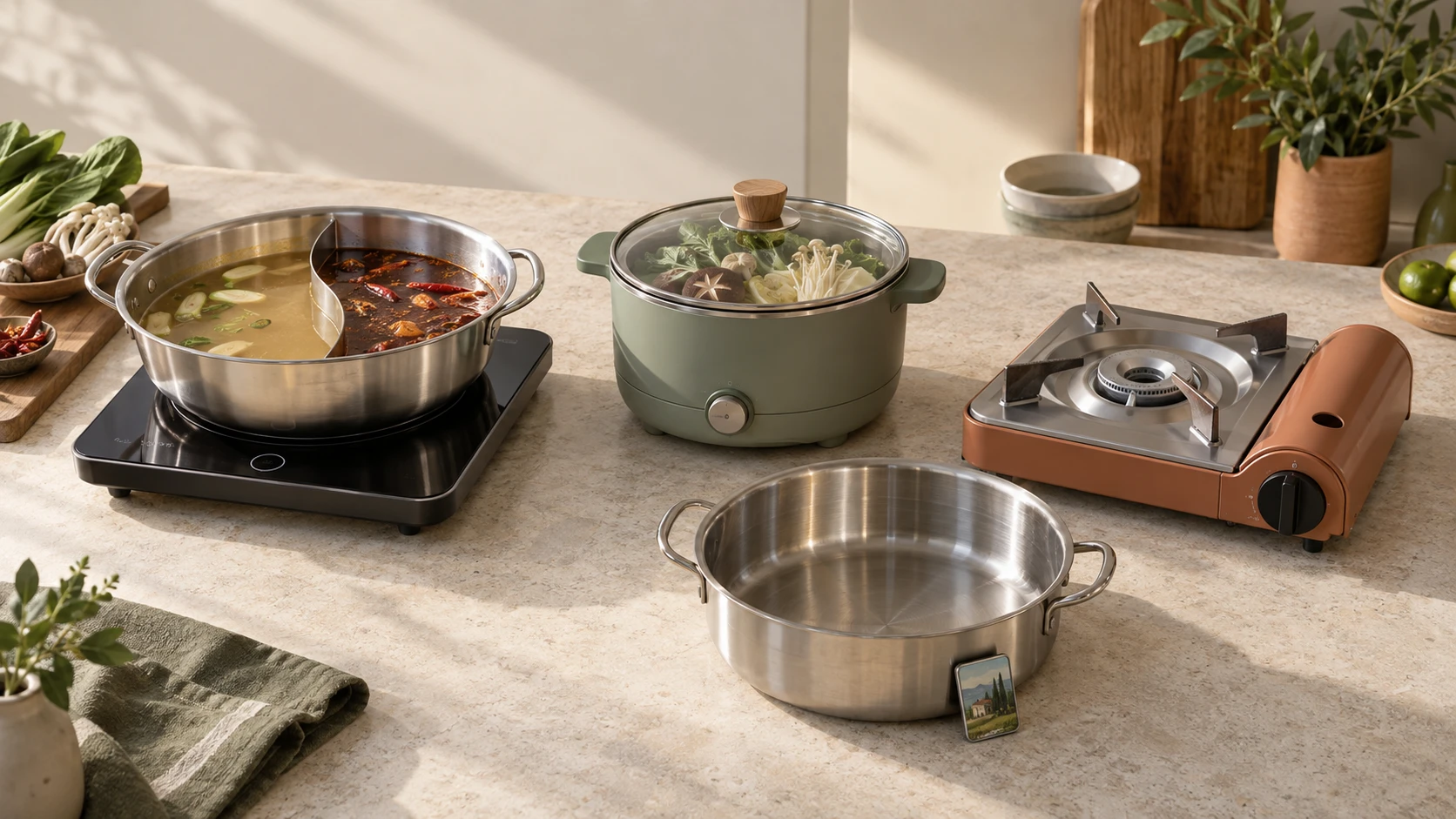
- A heat source at the table. A portable butane burner is the traditional answer and the cheapest. An electric hot pot with its own element is tidier and safer indoors, and an induction plate works if your pot is induction compatible. A slow cooker will not hold a simmer well enough. The three are compared properly in which burner and pot to buy.
- A wide, shallow pot. Surface area matters more than depth, because everyone needs to reach their own food. A divided pot is worth it if anyone at the table does not want chilli.
- A slotted spoon or small wire basket per person. The single thing that makes the meal work. Without one, people lose food in the broth and go fishing, which is how a piece of chicken ends up cooked for forty minutes and a prawn ends up cooked for twenty seconds.
- Small bowls. One for the dipping sauce and one to eat from.
- Chopsticks, and ideally a second pair. See the safety section below.
- A jug of hot water or spare broth. The pot reduces and gets saltier through the meal, and topping it up is normal rather than a failure.
How Much Broth Do You Need?
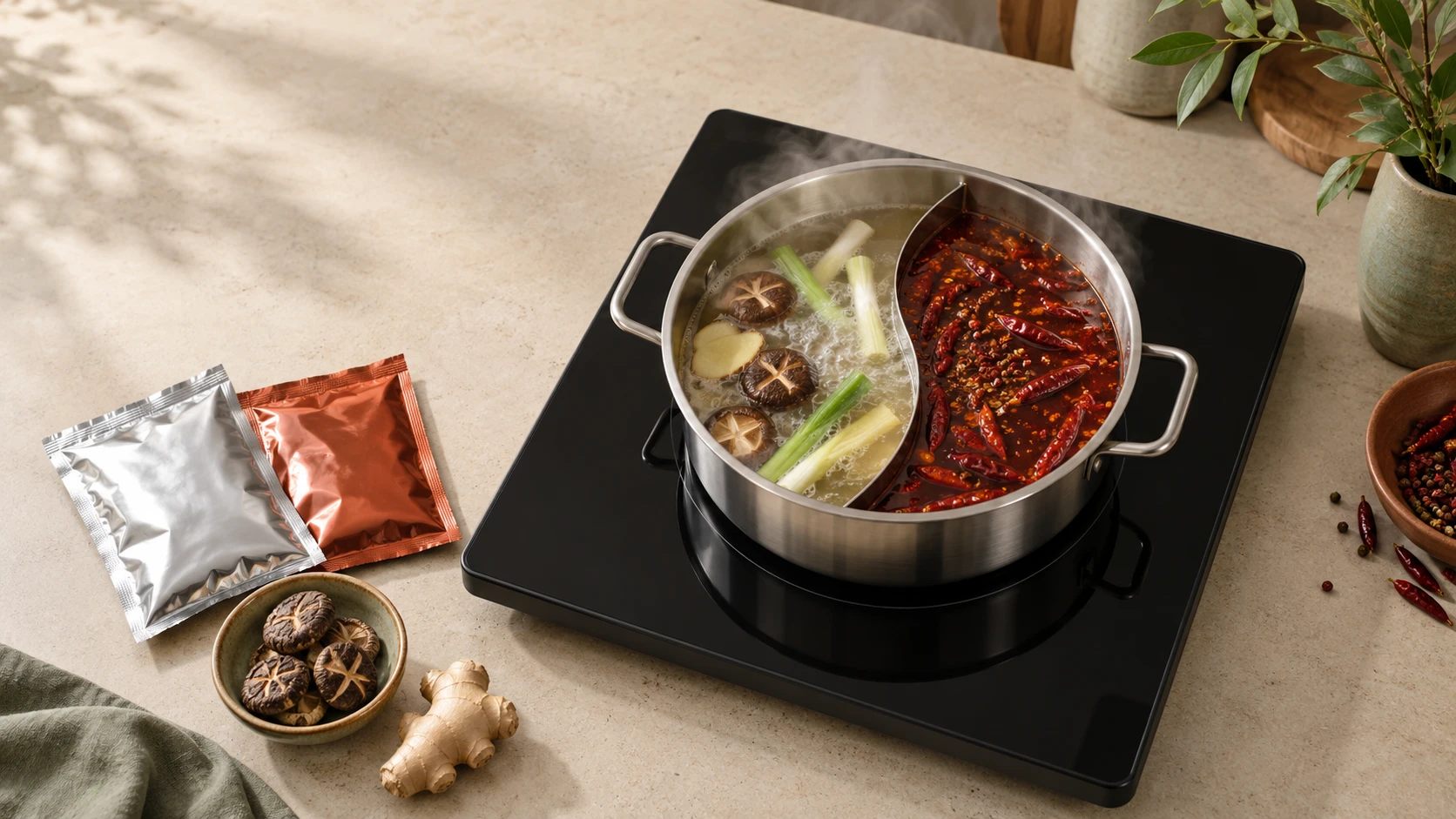
Fill the pot about two thirds. Any fuller and it boils over the moment somebody drops a plate of greens in, any emptier and it will not cover the food.
For four people that is usually 2 to 2.5 litres, and you should expect to add another litre over the course of the evening as it reduces. Keep the top-up hot in a kettle or a saucepan, because a litre of cold water kills the simmer for five minutes.
Which base to use, and how to make a mild one yourself, is in the broth guide. If you are using a packet soup base, start with less than it tells you and taste as you go. The broth gets saltier and more concentrated as it reduces, and everything you cook in it adds something back, so a base that tastes right at the start will be aggressive by the end.
Setting the Table
Put the pot in the middle and the raw food in a ring around it, so nobody has to reach across the burner. Keep raw meat and seafood on one side, together, and everything that goes in cooked or needs no cooking on the other.
Then get the broth to a proper simmer before anyone puts anything in. A pot that is merely hot poaches food slowly and grey. It wants to be bubbling steadily.
The dipping sauce station goes at the edge, away from the heat, so people can go back and adjust.
Hot Pot Cooking Times
These are guides for a properly simmering pot. Everything is faster than people expect, and the most common mistake at a first hot pot is overcooking the meat by a factor of ten.
| Ingredient | Time in the broth | How you know |
|---|---|---|
| Paper-thin beef or lamb | 10 to 30 seconds | It changes colour right through. Swish it rather than drop it |
| Thin pork belly | 30 to 60 seconds | Fat turns translucent |
| Sliced chicken | 2 to 3 minutes | No pink anywhere. Do not rush this one |
| Prawns | 2 to 3 minutes | Pink and curled, flesh opaque |
| Fish fillet pieces | 2 to 3 minutes | Opaque and flaking |
| Squid | 1 to 2 minutes | Curls and turns opaque. Longer makes it rubbery |
| Clams and mussels | 3 to 5 minutes | Shells open. Discard any that stay shut |
| Fish balls and hot pot balls | 4 to 6 minutes | They float, then give them another minute |
| Dumplings | 5 to 8 minutes | They float and the wrapper goes glossy |
| Firm tofu | 3 to 5 minutes | Heated through. It will not fall apart |
| Tofu puffs and fried tofu | 2 to 3 minutes | Swollen with broth |
| Leafy greens | 30 to 60 seconds | Wilted and bright |
| Napa cabbage | 2 to 3 minutes | Softened at the stem |
| Enoki mushrooms | 1 to 2 minutes | Limp and silky |
| Shiitake and king oyster | 4 to 6 minutes | Tender through the stem |
| Lotus root, potato, taro | 5 to 8 minutes | A chopstick goes through |
| Corn rounds | 5 to 8 minutes | Kernels plump |
| Fresh noodles | 2 to 4 minutes | Per the packet. Last of all |
Work in small batches. Six things in the pot at once drops the temperature, and then nothing cooks in the time the table says it should.
The Order to Cook In
There is a loose order, and following it makes the broth better as the night goes on rather than worse.
- Start with the slow, mild things. Corn, lotus root, daikon and the sturdier mushrooms. They take the longest and they sweeten the broth while everything else is still on the plate.
- Then meat and seafood, in rounds. This is the main part of the meal and where most of the eating happens.
- Tofu and balls alongside. They are forgiving and they soak up whatever the broth has become.
- Quick greens whenever. They take under a minute, so they slot in between rounds.
- Noodles or rice cakes at the very end. Starch clouds and thickens the broth, so once they are in, the pot is finished for cooking anything else.
The end of the meal, after the noodles, is when people ladle out the broth and drink it. It has had everything cooked in it by that point, which is the whole argument for the order above.
How to Build a Dipping Sauce
The sauce is not a garnish. In a mild broth it is carrying most of the flavour, and it is why two people eating from the same pot can have completely different meals.
Put the components out and let people build their own. The reliable formula is one salty base, one aromatic, one fresh thing and one optional heat.
- Salty base. Soy sauce, or sesame paste thinned with a little broth, which is the classic for lamb hot pot. Tamari if anyone is avoiding gluten, since ordinary soy sauce is brewed with wheat.
- Aromatic. Minced garlic, grated ginger, sesame oil, spring onion.
- Fresh. Coriander, chopped chilli, a squeeze of lime, black vinegar for sharpness.
- Heat. Chilli oil, chilli crisp, doubanjiang, or nothing at all.
- Optional. Sha cha sauce, fermented tofu, peanut butter, sugar, a raw egg yolk for shabu-shabu style.
A good default for somebody who does not know where to start: two parts soy sauce, one part sesame oil, a spoon of minced garlic, chopped spring onion, a little chilli oil. Thin it with a spoonful of broth from the pot.
Keeping Raw Meat Safe at the Table
This is the part of hot pot that gets skipped, and it is the only part with any real risk in it. Raw meat and seafood sit out at room temperature for the length of the meal while everybody handles them with the chopsticks they are also eating from.
- Use separate chopsticks or tongs for raw food. One set goes in the raw meat, another goes in your mouth. This single habit removes most of the risk.
- Bring meat out in batches. Keep the rest in the fridge and top up the plates. Two hours at room temperature is the outside limit, and less in a warm room.
- Keep raw plates away from cooked and ready-to-eat food. Separate side of the table, and do not return cooked food to a plate that held it raw.
- Chicken and minced meat get no shortcuts. Poultry needs to reach 74C (165F) all the way through, and minced meat 71C (160F) for beef, pork and lamb, or 74C for minced poultry. Whole cuts of beef, lamb and pork are 63C (145F). Fish is 63C (145F) too. Prawns, scallops, crab and lobster have no temperature target: cook them until the flesh is opaque and pearly.
- The thin-slice question. Paper-thin beef and lamb are traditionally swished for seconds and eaten barely cooked. That works because on a whole cut of meat the bacteria are on the outside surface, and boiling broth hits both surfaces of a very thin slice instantly. It does not transfer to chicken, and it does not transfer to anything minced, because mincing moves the surface right through the meat.
What to Do With the Leftover Broth
You will have a pot of concentrated, heavily seasoned broth at the end, and it is worth keeping. Cool it fast, refrigerate it within two hours, and use it within three to four days, or freeze it.
The catch is what has been cooked in it. A broth that has had raw chicken and seafood in it all night needs bringing back to a rolling boil before it is used again, and the cooling matters more than usual because a big pot of warm liquid takes a long time to get through the danger zone on its own. We have gone through it properly in can you reuse hot pot broth.
Frequently Asked Questions
How long does a hot pot meal take?
Two to three hours at the table, which is the point rather than a drawback. The prep is where the actual work is: an hour of shopping and chopping, or less if you buy pre-sliced frozen meat rolls from an Asian grocer.
What can I use instead of a hot pot burner?
An electric frying pan, an induction plate with a suitable pot, or an electric multi-cooker with a saute function will all hold a simmer. In a pinch you can cook on the stove and carry the pot to the table, but it cools within about twenty minutes and you will be getting up to reheat it.
Can you do hot pot without a divided pot?
Yes. Either run one mild broth and put the heat in the dipping sauces, which is what a chilli oil or doubanjiang in the bowl is for, or run two small pots. The mild broth plus hot sauces approach is easier and it lets each person set their own level.
Why is my hot pot broth too salty?
It reduced. Broth concentrates as it simmers, and packet soup bases are usually strong to begin with. Top up with hot water rather than more base, and start at less than the packet says next time.
What goes in a hot pot first?
The slow, mild things: corn, lotus root, daikon and firm mushrooms. They take the longest and they improve the broth for everything that follows. Noodles go last, because their starch thickens the pot.
Is hot pot healthy?
It depends almost entirely on what you put in it, which is truer of hot pot than of most meals because you choose every piece yourself. It is a lot of vegetables, lean protein and broth, cooked without frying. The things that change that are a fatty broth, a heavy sesame and peanut dipping sauce, and the salt, which is significant in most soup bases.
How much food do you need per person?
Around 150 to 200g of protein each alongside tofu, vegetables and noodles. The hot pot ingredients list has the full quantities and a shopping list for four.
Can you do vegetarian or vegan hot pot?
Easily, and a mushroom broth is one of the better bases anyway. Dried shiitake, kombu, ginger and spring onion make a deeply savoury stock, and tofu in its various forms, mushrooms, greens and noodles fill the table without anything missing.
The Rest of the Hot Pot Guides
- Hot pot equipment. Which burner to buy out of electric, induction and butane, what size pot feeds how many, and whether a divided pot is worth it.
- Hot pot broth. Which soup base to buy, how much water a packet really needs, and a mild base you can make in twenty minutes.
- Hot pot ingredients list. What to buy, category by category, with quantities per person and a shopping list for four.
- Can you reuse hot pot broth. Whether to keep it, how long it lasts, how to cool and store it safely, and when to throw it out.