Kitchenware · World Cuisines · Foodie Tips
Hot Pot Equipment: Which Burner and Pot to Buy
The short answer
For most people cooking hot pot indoors, a portable induction plate plus a wide stainless steel pot is the best buy. It is safe inside, the heat is instant, and the plate does other jobs the rest of the year. An all-in-one electric hot pot is simpler and cheaper to start with, but you are stuck with the pot it came with. Butane is the traditional answer and still the cheapest, and it is the one with real safety rules attached.
Which Hot Pot Burner Should You Buy?
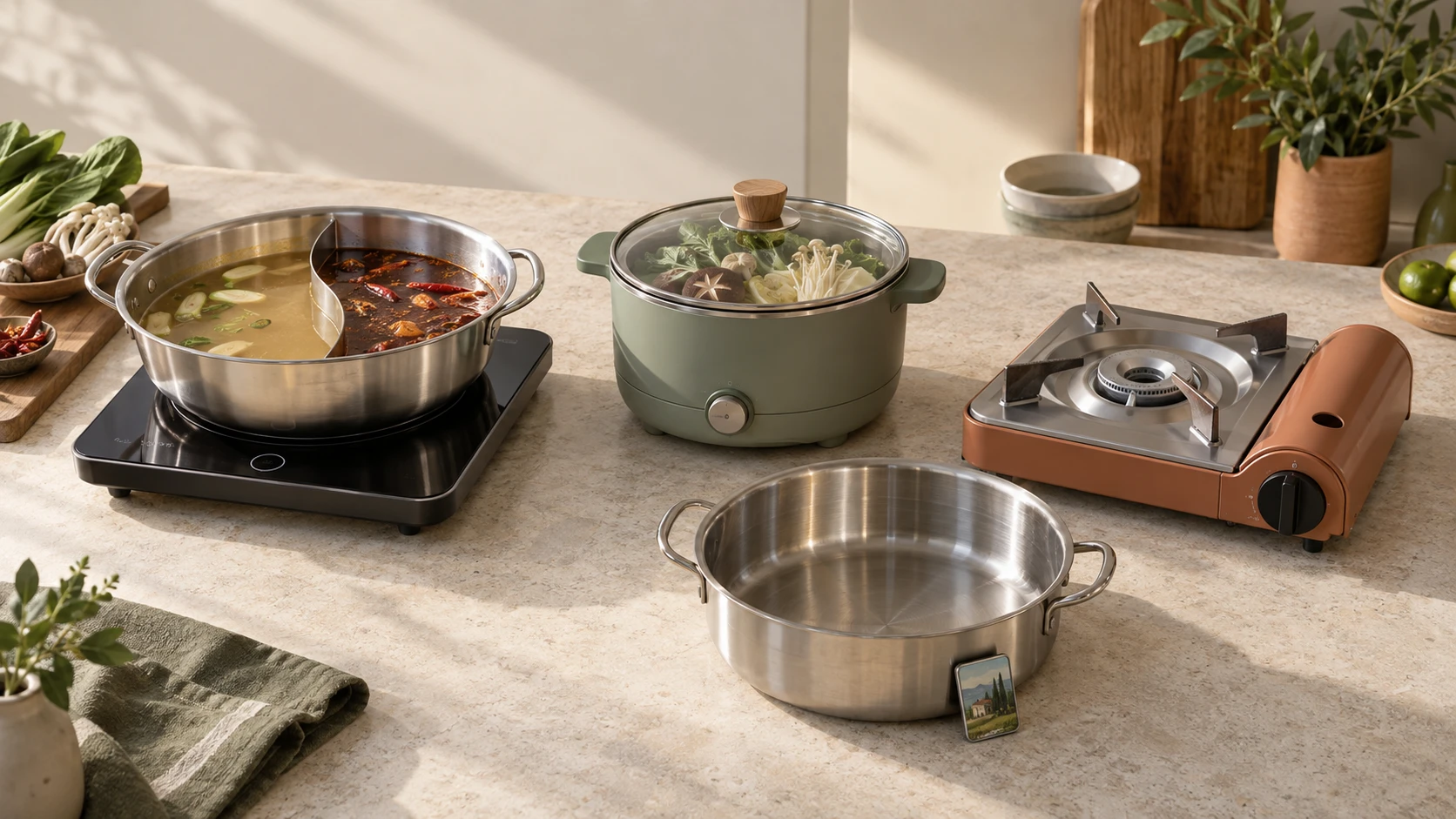
Three ways to get heat to the middle of a table, and the right one depends on how often you will do this.
Hot pot is not like other cooking. The pot sits where everyone can reach it, holds a simmer for an hour or more unattended, and is surrounded by people's hands and sleeves. That is the whole design problem, and it is why a slow cooker does not work: it will not hold a simmer, so the thin meat never cooks.
| Electric hot pot | Induction plate | Butane burner | |
|---|---|---|---|
| What you get | Pot and element in one unit | A plate. Pot bought separately | A burner. Pot bought separately |
| Safe indoors | Yes | Yes | Only with ventilation |
| Heat control | Dial or presets, slow to respond | Instant, precise | Instant, by flame |
| Needs power at the table | Yes | Yes | No |
| Can you swap the pot | No | Yes, if it is magnetic | Yes, any pot |
| Other uses | Little. It is a hot pot | A spare hob all year | Camping, power cuts |
| Main drawback | Fixed pot, often a thin one | Fussy about the pot's base | Gas canister safety |
Twice a year, buy the cheapest thing that is safe. A regular winter habit, and the induction plate is the one you will still own in five years, because the plate and the pot fail independently and you replace whichever gives out.
Electric Hot Pots: What You Get
An electric hot pot is a pot with a heating element built into its base and a dial on the side. Plug it in, fill it, turn it up.
The appeal is one purchase, one thing to store, no gas and no separate plate. For a first hot pot it is a reasonable way in.
Check two things. Wattage decides whether it can bring a full pot back to a simmer after somebody drops in a plate of frozen dumplings; around 1300W is what the better units run, and cheap ones sit well under it. And look hard at the pot, because you cannot change it: on most of these it is thin coated aluminium, which gives a ring of fierce heat in the middle and cool edges.
The real limitation is that the pot and the element are one object. When the coating goes, and on a thin pot scraped with metal tongs it will, the whole appliance is finished.
Induction Plates: The Flexible Option
A portable induction plate heats the pot directly through a magnetic field, so the glass top never gets hotter than the pot standing on it.
For a table full of people this is the safest of the three. No flame, nothing to knock over, the surface around the pot cool enough to touch, and an instant response, so you can knock it back when it boils over instead of waiting for an element to cool. Between hot pot nights it is a spare hob, which is more than the other two can say.
The catch is that it is fussy about pots. Induction only works on a pot with a magnetic base, and plenty of stainless steel is not magnetic. The 300-series steel used in cheaper pots has too much nickel in it and the field passes straight through.
Test before you buy: hold a fridge magnet to the base. A firm grab means it will work, a weak pull or none means it will not. Do that in the shop, not at home afterwards.
Cast iron and carbon steel always work. If a pot you already love fails, an induction interface disc sits between plate and pot and gets you most of the way, at the cost of some responsiveness.
Butane Burners: Cheap, and the One With Rules
The portable butane burner is what hot pot restaurants use and what most people picture. It is the cheapest option, it works anywhere, and it needs more care than the other two.
Safety
Never use a pot wider than the burner's trivet. An overhanging pot traps heat and radiates it down onto the gas canister, and an overheating canister can vent or burst. This is the main way these stoves hurt people, and hot pot is the exact situation that causes it, because a hot pot is wide and a portable burner is small. Use butane in a ventilated room, never a sealed one, and never treat it as a heater.
That rule is worth taking seriously because it became a regulatory matter. In March 2015 Australian gas regulators tested the cheap "lunchbox" cookers, the ones where the canister lies flat inside the body, and found a fault in the shut-off valve meant to stop canisters over-pressurising when they overheat. Up to 31 models were pulled, certification was suspended, and they could no longer be sold lawfully in New South Wales. The ban went on to cover Victoria, Queensland, Western Australia, South Australia and the Northern Territory, and reported injuries ran from scalds to serious burns.
The part people miss is what happened next. Models were redesigned and retested against revised Australian Standards, and the ones that pass carry a new certification number. Their cartridges now use a countersink release vent, which bleeds gas off gradually under over-pressure rather than letting the can fail at once.
So butane is not off the table. In Australia, buy a currently certified stove and matching cartridges rather than the cheapest thing at the market, and check the certification number. Elsewhere that ban does not apply, but the physics does: the failure mode was heat reaching the canister, and a wide pot on a small burner is what puts it there.
What Size Pot for How Many People?
Go wider rather than deeper. Everyone at the table has to reach their own food, and a deep pot means fishing.
- Two people: about 2 to 3 litres, roughly 24cm across.
- Three or four: about 4 litres, roughly 28 to 30cm. This is the size most households want.
- Five or six: about 6 litres, 32cm or more.
- More than six: two pots and two burners, not one enormous pot. Eight people cannot reach one pot, and the ones at the far end stop eating.
Fill it about two thirds, and see the main hot pot guide for why, and for how much broth that works out to per person.
Divided Pots: Yin Yang, S-Shape or Nothing?
A divided pot runs two broths at once, which is the difference between everyone eating and the person who cannot take chilli picking at vegetables.
The classic is the yin yang, a wall across the middle giving two equal halves. The S-shaped divider is the same idea curved, and looks less like a fence down the table. Some larger pots use a small inner ring for the spicy broth instead.
It comes down to one question: is there anyone in your house who will not eat the spicy side? If yes, buy divided and stop thinking about it. If everyone eats the same, a plain pot holds more, washes easier and costs less.
Two things to check on a divided pot. The divider should be welded or pressed as part of the pot rather than a loose insert, because a loose one leaks and you end up with one broth. And each half should still be wide enough to cook in, which is the reason a divided 24cm pot is usually a mistake: half of it is not much of a pot.
What the Pot Should Be Made Of
Stainless steel, and thicker than you think you need.
Hot pot broth is salty, often acidic, and sits at a simmer for an hour with metal tongs going in and out of it all night. That is hard on a coating, and nonstick buys you nothing here, because nothing sticks to a pot full of soup.
What matters is the base. A thin base concentrates heat in the middle and warps, especially if it gets carried to the sink hot and filled with cold water, which is exactly what happens at the end of a hot pot night. A thick base, or a multi-ply one with an aluminium core between layers of steel, spreads heat and stays flat. On induction, a flat base is not a nicety, because a warped pot rocks on the glass and heats unevenly.
Cast iron works and holds heat beautifully, but it is heavy to lift full and slow to respond, and on a table with kids around it the weight is a real consideration.
The Small Things That Make It Work
The burner and the pot get all the attention. These cost very little and make more difference to the evening.
- A small wire basket or slotted spoon per person. The single most useful thing on this page. Without one, people lose food in the broth and go fishing, and a prawn that should have taken ninety seconds comes out after twenty minutes.
- A fine mesh skimmer. Scum and loose starch build up as the night goes on. One pass every so often keeps the broth clear.
- A ladle that fits. For serving broth into bowls at the end, which is the best part of the meal.
- Two small bowls each. One for dipping sauce, one to eat from.
- A second pair of chopsticks or tongs, in a different colour, kept for raw meat only. Not optional. See the safety section of the main guide.
- A trivet or heat mat under the burner. Whichever heat source you pick, something under it.
What You Can Skip
Hot pot sets sold as a bundle usually pad the box out. You do not need a lazy susan, a set of themed sauce dishes, or the little numbered baskets that stop one person cooking more than their share.
You also do not need a lid. Hot pot is cooked open, and a lid on the table is one more hot thing to put somewhere.
And you do not need a second burner for four people. Two pots is a solution to the reach problem on a long table, not an upgrade.
Frequently Asked Questions
Can you use a slow cooker for hot pot?
Not really. A slow cooker will not hold a proper simmer, and hot pot depends on broth hot enough to cook thin meat in seconds. You can keep broth warm in one, but you cannot run the meal from it.
Can you use an electric frying pan?
Yes, and it is the best thing to try before buying anything. A deep electric frying pan holds a simmer, sits on the table, and is the same idea as an electric hot pot. It will be shallower than ideal, so fill it less and top it up more often.
Do you need a divided hot pot?
Only if someone at your table will not eat the spicy broth. If that is the case it is the best money on this page. If everyone eats the same, a plain pot is bigger, cheaper and easier to wash.
Will my pot work on an induction plate?
Hold a fridge magnet to the base. A firm grab means yes, a weak pull or none means no. Cast iron and carbon steel always work. A lot of cheaper stainless steel does not, because of the nickel content in the steel.
Is it safe to use a butane burner indoors?
With ventilation and a certified stove, yes, and it is what restaurants do. In a sealed room it is not, because a burner consumes oxygen and can start producing carbon monoxide. Never use a pot wider than the trivet, since that is what drives heat down onto the canister.
Can you put a hot pot in the dishwasher?
A plain stainless pot usually yes. An electric hot pot never, because the base holds the element and the wiring. Check the manual, and in either case do not fill a hot pot with cold water, which is how bases warp.
The Bottom Line
Induction plate plus a thick-based stainless pot if you expect to do this often. An all-in-one electric unit if you want to try hot pot without committing. Butane if you want the restaurant setup or you need to cook away from a power point, bought certified and used with a pot that fits the burner.
Then read how to set it up and run it, choose a broth, buy from the hot pot ingredients list, and when it is over, work out whether to keep the broth. There are more kitchenware guides here.